February 19, 2026 - February 22, 2026
Generations Sector, Booth G9
Exhibiting Artists:
Kaleab Abate (b. 1998, Ethiopia; based in Addis Ababa, Ethiopia)
Henry Mzili Mujunga (b. 1971, Uganda; based in Kampala, Uganda)
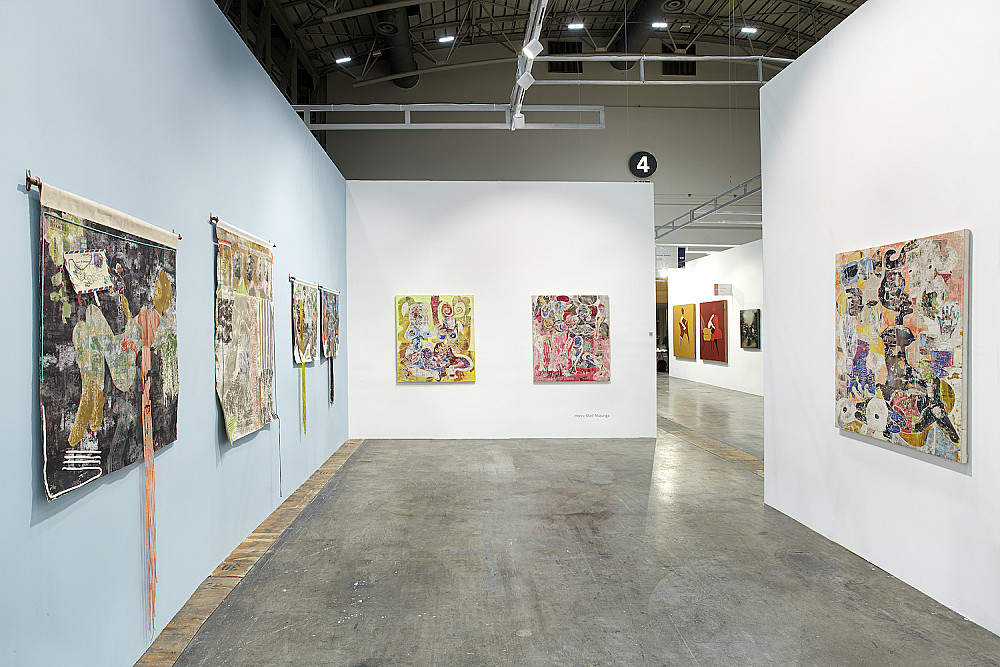
At the 2026 edition of INVESTEC Cape Town Art Fair, Afriart Gallery presents the work of Kaleab Abate and Henry Mzili Mujunga, two artists whose works navigate the entanglement of memory, transformation, and identity within rapidly shifting urban and cultural landscapes. For each, the city, Addis Ababa for Abate, Kampala for Mzili, is both muse and archive.
Abate’s layered works embody the turbulence of a city in transition. Fragmented figures, surreal forms, and layered textures mirror the dissonance of today’s Addis Ababa, where nostalgia becomes not a safe haven but a resource – a way of piecing together identity amid rupture. What surfaces is not romantic but speaks of resilience, insisting on survival through reassembling fragments into new constellations of meaning. The artist created Addisalem, a character often appearing in his new body of work. Named after the Amharic word for “new world” and embodying the spirit of Addis Ababa, she became his way of giving the city a voice, someone he could question, confide in, and converse with. In her, the city transforms into a living presence, both familiar and mysterious, inviting dialogue and reflection.
Mzili turns toward the intimacy of lived environments and quieter registers of experience in Kampala, where the everyday becomes a site of empathy, spirituality, and connection. Long attentive to domestic and shared spaces, his recent work incorporates image transfer, collage, and mixed media, drawing intuitively from his personal photographic archive alongside fragments of fabric, garments, and printed matter. Resisting conventional painterly gestures, his dragged, smeared, and printed surfaces blur the boundaries between painting and printmaking. Anchored by the recurring presence of the African mask, his practice sustains a productive tension between inherited visual traditions, urban culture, and entanglements with Western modernist histories.
Abate builds through fragmentation and nostalgia, Mzili gathers through attention and intimacy. For both the city is a terrain of imagination, care, and memory. Their work opens a space for the tenderness of connection, and for reflection on both the resilience and transformation of identity.
Eventually, their juxtaposition also highlights how identity might be negotiated across time – between the restless energy of youth and a tempered, steady perspective built over time. Abate, shaped by the accelerations of a 21st-century Addis, is concerned with the urgency and instability of a rapidly globalizing city, while Mzili shows a measured, quiet attentiveness grounded in decades of reflection and artistic practice.


